Chapter 01 / Mechanics
How AWD and 4WD Actually Work: A Mechanical Guide
To understand AWD vs 4WD, you have to understand three components: the differential, the transfer case, and the center differential. Everything else flows from there.
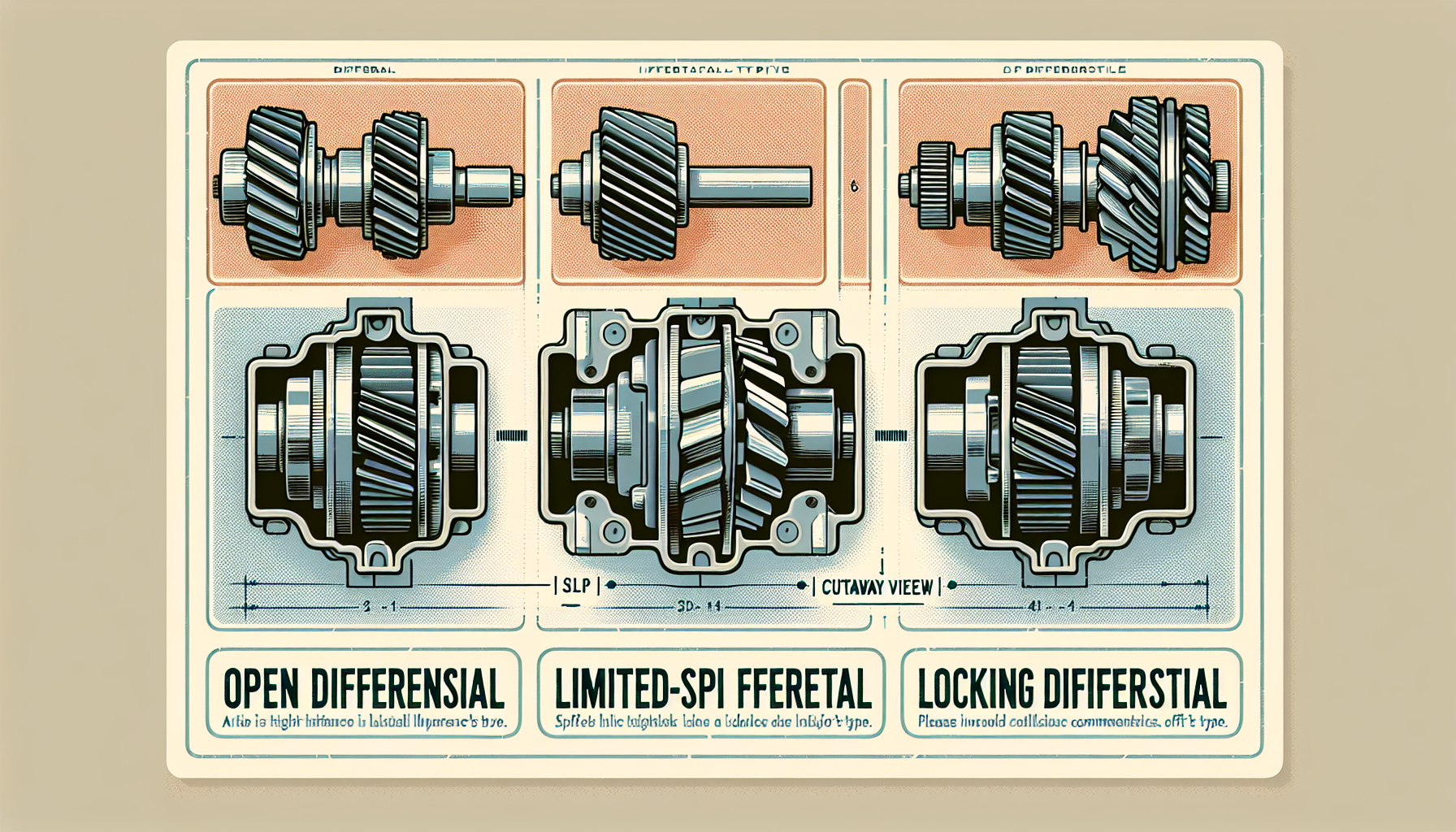
The Differential: How Power Reaches the Wheels
Every driven axle on every car has a differential. Its job is to allow the two wheels on the same axle to spin at different speeds. When you turn left, your right wheels travel a longer arc than your left wheels. The differential accommodates that difference through a set of bevel gears.
The problem with a basic open differential is that it always sends power to the wheel with the least resistance. On a slippery surface, that is the wheel with no traction. One wheel spins in the air or on ice while the other sits still with all the grip. This is where limited-slip and locking differentials come in.
Open Differential
Standard equipment on most base-trim vehicles. Works perfectly on dry pavement because there is always some resistance at each wheel. Fails in low-traction situations where one wheel has far more grip than the other. Budget vehicles, economy crossovers, and most front-wheel-drive cars use open diffs on both axles.
Limited-Slip Differential (LSD)
An LSD adds friction to the differential internals using one of three mechanisms: a clutch pack (most common, used in Subaru WRX, BMW M vehicles, Audi Sport diff), viscous fluid coupling (older Subaru models, older Haldex systems), or a Torsen gear set (Audi quattro longitudinal models, Humvee, some F-150 Raptor axles).
When one wheel starts spinning faster than the other, the LSD applies resistance proportional to the speed difference. This redirects torque toward the slower, grippier wheel. A Torsen differential is the fastest-responding type because it reacts mechanically and instantly, with no electronic lag. Clutch-pack LSDs respond within 50 to 200 milliseconds. Viscous couplings are slowest, reacting over several hundred milliseconds as the fluid heats and thickens.
Locking Differential
A locking differential bypasses the differential action entirely and forces both wheels to spin at exactly the same speed. This is the only truly capable solution for serious rock crawling where one wheel may be completely airborne. Found on the Jeep Wrangler Rubicon (front and rear Tru-Lok lockers), Toyota 4Runner TRD Pro (electronic locking rear differential), Ford F-150 Raptor (Torsen front, electronic rear), and Land Rover Defender (optional rear locker via Capability Pack). Locking differentials must be disengaged on dry pavement or any high-traction surface.
The Transfer Case: Only on 4WD
AWD vehicles do not have a transfer case. They use a center differential, viscous coupling, or multi-plate clutch to split power front to rear. 4WD vehicles use a transfer case, which is a second gearbox mounted behind the main transmission. It physically splits the output to a front driveshaft and a rear driveshaft.
Most transfer cases have two ranges. High range (1:1) drives all four wheels at normal highway ratios. Low range adds a gear reduction, typically 2.5:1 to 4:1, which multiplies torque dramatically at the cost of speed. The Jeep Wrangler Rock-Trac transfer case has a 4.0:1 low range. The NV231 found in base Wranglers and many older Jeeps has a 2.72:1 low range. Land Rover Defender uses a 2.93:1 low range. These ratios mean that in 4L, the engine can produce four times its peak torque at the axles while crawling over obstacles at 2 to 5 mph.
Transfer case internals are either chain-driven (most common, used in BorgWarner NP231 and NP241, lighter, quieter) or gear-driven (older and more truck-focused units like the NP205, heavier, stronger, noisier). The NP205 is nearly indestructible and was used in pre-2000 heavy-duty trucks and military vehicles. For the vast majority of buyers, the BorgWarner chain-driven cases in modern trucks are perfectly adequate.
The Center Differential: Why AWD is Safe on Dry Pavement
AWD vehicles need a way to allow the front and rear axles to rotate at slightly different speeds even during normal driving. When cornering, the front axle travels a different arc than the rear axle, just as each wheel does within an axle. If the front and rear were locked together, the drivetrain would bind on every turn, even on dry pavement.
Subaru uses a mechanical viscous coupling or planetary center differential depending on the drivetrain variant. Audi quattro Torsen systems use a gear-based center differential that reacts instantly without electronics. BMW xDrive, Mercedes 4MATIC, and Haldex-based systems (Audi A3 and TT, Volkswagen 4Motion, Volvo XC) use an electronically controlled multi-plate clutch. Part-time 4WD vehicles have no center differential at all, which is why 4H cannot be used on dry pavement.
CV Joints and U-Joints
AWD vehicles use constant-velocity (CV) joints on all four axle shafts. CV joints allow the shaft to flex at the steering angle while transmitting power smoothly. This is why your front wheels can steer while also being driven. CV joints typically last 100,000 to 150,000 miles before the rubber boot cracks and the grease inside escapes. Once grease-contaminated, the joint wears quickly. Replacement cost runs $300 to $900 per side including labor, higher on German-brand AWD vehicles where the front subframe must often be partially dropped.
Traditional 4WD trucks with solid front axles use U-joints (universal joints) instead of CV joints. U-joints are simpler and stronger but cause vibration at high steering angles. Newer 4WD trucks with independent front suspension (IFS) use CV joints on the front axle, sacrificing some off-road articulation for better ride quality. The Ford F-150, Silverado 1500, and Ram 1500 all use IFS with CV joints. The Jeep Wrangler, Toyota 4Runner, and Land Rover Defender use solid axles with U-joints for maximum off-road travel.
Power Flow: Three Representative Systems
Subaru Symmetrical AWD (Manual Transmission)
Subaru's boxer engine sits longitudinally, and the transmission output connects directly to a viscous center coupling or a planetary center differential. This gives a near-equal front-to-rear weight distribution and driveshaft lengths. On manual-transmission Subarus, the center diff is a pure mechanical planetary type with a 50/50 default split and a viscous LSD that tightens the split under wheel spin. On CVT models, the Variable Torque Distribution (VTD) system uses an electronically controlled hydraulic multi-disc clutch to run 45/55 front/rear normally and adjust under slip. The result is a system that is always engaged, requires no driver intervention, and in the case of the WRX STi, can be manually biased via the DCCD dial.
Jeep Wrangler Rubicon Rock-Trac 4WD
The Rubicon's Rock-Trac transfer case (a BorgWarner NP241OR) has a 4.0:1 low range and no center differential. In 4H, the front and rear Dana 44 axles are locked together. This is safe on dirt, gravel, snow, and off-road surfaces where tires can slip a little to equalize speed differences. In 4L, you add the full torque multiplication. Combined with the front and rear Tru-Lok electronic lockers, the Rubicon can put equal power to all four tires simultaneously regardless of traction, which is the only way to climb certain rock formations. The electronic front sway-bar disconnect allows the suspension to flex independently at low speeds, massively increasing axle articulation.
Audi quattro ultra (A4 / A5)
The quattro ultra is a fuel-efficiency-focused version of quattro that runs front-wheel drive by default. A predictive multi-plate clutch center coupling sits between the transmission and the rear driveshaft. Sensors monitor steering angle, throttle position, wheel speed, and lateral acceleration. When the system predicts wheel slip is imminent or detects it occurring, the clutch engages within approximately 200 milliseconds and drives the rear axle. In city driving, the rear driveshaft is often completely disconnected, saving approximately 0.3 MPG versus the full-time Torsen quattro in comparable models. The tradeoff is that response is slightly slower than the mechanical Torsen in fast, loaded cornering.
Quick Reference
- AWD: center differential or clutch pack, always safe on dry pavement
- 4WD: transfer case, part-time requires slippery surface in 4H
- Open diff: power to wheel with least traction (bad for low-grip)
- LSD: transfers torque to wheel with more grip (good for all conditions)
- Locker: forces equal axle speed (essential for rock crawling)
- Torsen: gear-based LSD, fastest reaction time, zero electronics
Frequently Asked Questions
What does a differential actually do?+
A differential allows the two wheels on the same axle to rotate at different speeds. When you turn a corner, the outside wheel travels a longer arc than the inside wheel. Without a differential, both wheels would be forced to spin at the same rate, causing the tires to scrub and skip. The differential uses a set of bevel gears to split the torque from the driveshaft and allow each wheel to spin at the speed the road demands.
What is a limited-slip differential and when do I need one?+
A limited-slip differential (LSD) adds a clutch pack, viscous fluid, or Torsen gear set to the standard open differential. When one wheel starts to spin freely, the LSD transfers torque to the wheel with more grip rather than allowing all power to go to the spinning wheel. You benefit from an LSD in snow, mud, and cornering performance. Most AWD systems include some form of LSD on at least one axle.
Why does part-time 4WD damage on dry pavement?+
Part-time 4WD locks the front and rear driveshafts together through the transfer case. When turning on a high-traction surface, the front wheels need to rotate faster than the rear wheels. With the transfer case locked, the driveshafts cannot accommodate that speed difference. The strain is absorbed by the tires scrubbing, the transfer case binding, and eventually gear wear or chain stretch. On slippery surfaces, the tires slip slightly to equalize the rotational difference, which is why 4H is safe on snow or gravel but not on dry asphalt.
How is AWD different from a locking center differential?+
A true locking center differential allows you to manually lock the front and rear axles to spin at equal speed, which is useful in deep mud or rock crawling. Standard AWD uses an open center differential, viscous coupling, or multi-plate clutch that allows limited speed difference between front and rear axles at all times. Full-time 4WD (Range Rover, G-Wagen) works the same way: a center diff is always active, and you can lock it for extreme off-road use.
Next in the guide
Types of AWD SystemsThe five AWD philosophies: full-time symmetrical, Torsen, on-demand, torque-vectoring, reactive
Practical use
Maintenance and CostsCV joint replacement, differential fluid intervals, real cost estimates
Data verified April 2026. Specifications vary by model year, trim, and configuration. Verify with manufacturer before purchase.